Posts Tagged ‘Denver Landmarks’

Downtown Denver Public Library

Denver-public-library-books-graphic The Denver Public Library Downtown Branch is located on the Southeast edge of the main downtown Denver area next to the Denver Art Museum and Civic Center Park with both the Colorado State Capitol Building, and the Denver City and County Buildings near by. Branch libraries are located through out the city.

The library building itself is something of an interesting architectural piece. On one hand, the building is composed of perfectly normal building shapes and colors, just like you would draw in a picture, and that is its genius. Of course, real buildings typically don’t look like the ones drawn on paper, but this one does. It is pastel colored with each segment of the building forming a perfectly drawn shape, cylinders, rectangles, and squares.

Inside, the Denver Public Library book collection sprawls across four floors. The library Children’s section is on the first floor, as is the Reference Section, and the popular fiction and multimedia section. The top three floors contain the bulk of the library’s books and are categories in the traditional Dewey Decimal System manner.

The library has numerous computer workstations with public Internet access. This can make finding a free one can be difficult despite time limits placed on consecutive usage, as many people camp out for as long as they are allowed online. For that reason, it is advisable to search the library’s card catalog online prior to visiting if you are looking for something specific. Otherwise, a handful of computers scattered throughout the library are marked as being either Card Catalog Only, or No Internet Access. These stations are generally not occupied.

Residents of Denver can use the online catalog to not only search for materials, but also to place books, DVDs, and CDs on hold. The great thing about the system is that in addition to reserving the materials, the user may also choose where to pick up the materials, meaning that there is no need to drive all over town to a specific library to get the book you want. Simply place a hold on the book and select your nearest Denver Library Branch to pick it up.

Denver Public Library Hours

The main downtown branch of the library is open every day, although only for a half a day on Sundays.

However, all local branch library locations are closed on Sunday. Additionally, falling tax revenues have caused Denver and the library system to endure major budget cuts. Unfortunately one money saving method being used is closing branches for additional days. The 2010 Library Schedule of hours has most branches closed on Sundays and two other days each week, so check the Denver Library Hours prior to venturing out.

Be the first to comment - What do you think?  Posted by DenverFun - January 30, 2010 at 12:20 am

Categories: Downtown Denver   Tags: , , , , , , , , ,

Denver City Layout

Which Way Is North?

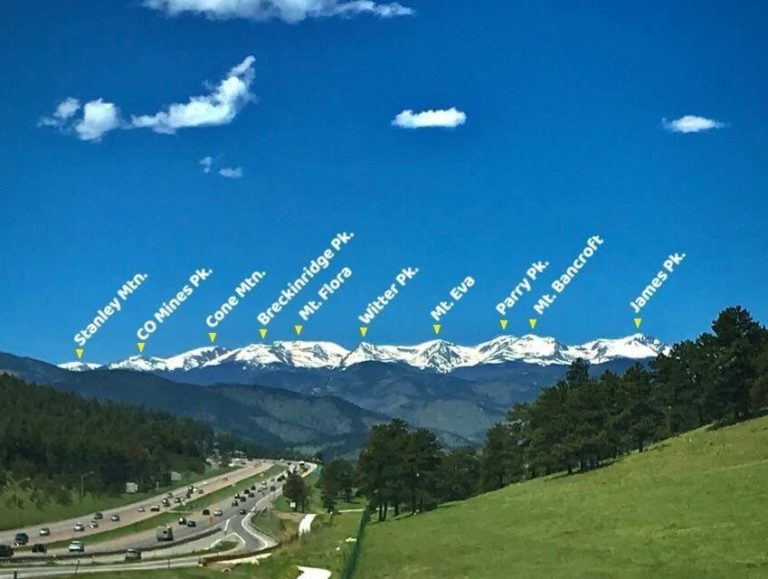
Getting your bearings in most cities can be a challenge. In Denver, and anywhere along the Front Range for that matter, finding North, South, East, and West is as easy as finding the mountains. The Rocky Mountains are to the West.

If you are ever lost or confused, just take a minute to look around. Find the mountains; that is west. You can take it from there.

(For the super directionally challenged, if you are looking West, North is to the right, and South is to the left. East is behind you.)

Denver City Streets

Like most cities, Denver has a network of streets crisscrossing its downtown area. Unlike, most cities, those streets are not always laid out on a North-South and East-West axis.

denver-street-layout-graphicMany of Denver’s downtown streets are laid out diagonally, more on a Northeast to Southwest and Northwest to Southeast type grid. The reason for this unusual layout?

Early on in Denver’s history, the streets were actually laid out so that if you looked down the street (to the Southwest) you would see Pikes Peak. The name streets are laid out in this direction. They are crossed at the standard 90 degrees by the numbered streets. This arrangement was abandoned later, but not before Denver ended up with a “weird” layout for almost all of its downtown streets. It also makes for some interesting intersection where the “normal” North-South/East-West streets meet their diagonal counterparts.

Numbered Streets

The numbered streets in Downtown Denver run from lower numbers to the south toward higher numbers to the north.  Thus, 14th Street is south of 15th Street.

The crossing streets are named streets. These streets do not progress according to any external order. (They are not alphabetical, for example).

Denver Landmark Locations

A handful of Denver Landmarks and Attractions make for useful directional landmarks.

The Pepsi Center, home of the Colorado Avalanche and Denver Nuggets, is in the Southwest corner of downtown, while Coors Field, home of the Colorado Rockies, occupies the Northwest corner.

The Denver City and County Building and the Colorado State Capitol building flank Civic Center Park on the eastern edge of downtown.

Be the first to comment - What do you think?  Posted by DenverFun - September 4, 2009 at 5:01 pm

Categories: Denver Sightseeing   Tags: , , ,

About Denver

The City and County of Denver is Colorado’s largest city, as well as the capital city of Colorado.

Denver is known as the Mile High City because it’s elevation is 1 mile above sea level. There are many Denver attractions that mark the spots where the elevation is exactly 5280 feet. The 13th step of the Colorado State Capital Building, and the purple row of seats inside Coors Field, home of the Colorado Rockies, are two examples.

History of Denver

Like many cities in the West, Denver got its start as a gold mining camp after prospectors discovered gold where the South Platte River and Cherry Creek meet. The mining camp grew into a major city in the area thanks to the railroads.

Denver Population

The US Census Bureau pegs Denver’s population at 598,707. However, most people would consider the city to be much larger. While Denver’s official boundaries contain just under 600,000 residents, this reflects a law which prevented Denver from annexing any new land, thus, artificially limiting its size. The surrounding area, known as the Denver Metro Area, has closer to 2 1/2 million people.

Denver Weather

Modern technology obscures Denver’s semi-arid climate. The area averages just 13 inches of total precipitation each year. While the city does get snow in the winter, most storms pack less than an inch or two of accumulation. Most of the time, the snow melts away the next day, sparing Denver the slush and grayness that can plague other wintry cities.

While spring Thunderstorms can be powerful, Denver’s location next to the Rocky Mountains spares it from most of the severe weather, particularly tornadoes, that is common in its neighbors to the east.

Together, these factors provide for very sunny conditions, regardless of temperature, throughout the year. Denver boasts of 300 days of sunshine a year. Don’t let that fool you into thinking the weather is always the same, though. A favorite saying of the locals is, “If you don’t like the weather, just wait five minutes.”

Denver Geography

Denver sits just to the east of the Rocky Mountains, known throughout the region as “The Rockies.” The mountains do not rise abruptly out of the plains. Rather, a ridge of hills in front of the Rocky Mountains runs from North to South. These hills are called the foothills and are often mistaken for the Rockies that lie behind.

The hills in the front are typically more purple while the mountains behind tend toward blue. The tallest mountain peaks visible from Downtown Denver, like Pikes Peak and Longs Peak have snow on them year round (it’s the white that you see).

Denver does sit in a slight depression which can result in hazy days when the air is calm and the temperatures are right, often resulting in what is called an inversion.

Otherwise, Denver’s sunny skies often seem unusually blue to visitors. This isn’t your imagination, there is less atmosphere at 5200 feet which makes the sun brighter and the skies bluer. It also makes it easier to get sunburned!

Where to go in Denver?

Be the first to comment - What do you think?  Posted by DenverFun - September 2, 2009 at 11:54 am

Categories: Denver Sightseeing   Tags: ,